
Around the world, we throw away an astonishing share of the food we grow. Roughly one-third of all food produced is lost or wasted each year, even as hundreds of millions of people do not know where their next meal will come from. This isn’t just a tragedy of inefficiency. It’s a human rights failure.
In a new article in the Vanderbilt Journal of Transnational Law, “From Surplus to Sustenance: Confronting Food Waste to Uphold the Right to Food” Emily M. Broad Leib and Noelle Musolino argue that governments that fail to tackle food loss and waste (FLW) are failing to uphold the right to food—a right recognized in international law by the vast majority of countries.
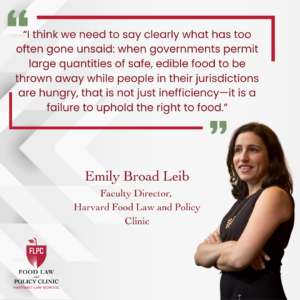
“I think we need to say clearly what has too often gone unsaid: when governments permit large quantities of safe, edible food to be thrown away while people in their jurisdictions are hungry, that is not just inefficiency—it is a failure to uphold the right to food,” Emily Broad Leib said. “International law requires states to respect, protect, and fulfill that right, and unmitigated food loss and waste cuts against each of those duties. At the same time, we now know what works: clear food safety rules for donation, liability protections that support good faith donation, smart tax design, donation requirements, and public investment in food recovery infrastructure. Countries at every income level are already using these tools. The real question is no longer whether we can tackle food waste to advance the right to food, but whether governments are willing to take responsibility for doing what we know is both possible and necessary.”

The Right to Food Meets Food Waste
International human rights law defines the right to food in concrete terms: food must be available, accessible, adequate (including safe and nutritious), and sustainable for present and future generations. States must respect, protect, and fulfill this right.
FLW cuts against each of these elements. Destroying edible food reduces availability and accessibility, especially for people already on the margins. Landfilling that food squanders land, water, and energy and drives climate change, endangering future food security.
At the same time, recovering surplus safe food can directly support the right to food, especially the state’s duty to “fulfill” the right by providing food or facilitating access for people who cannot secure it themselves. Governments must play a role to ensure this distribution takes place, and that the food donated is safe, edible, and of high quality.
“Pope Francis once said ‘Throwing away food is like stealing from the table of those who are poor and hungry,’ and it’s true,” co-author and Attorney Noelle Musolino said. “In a world where there are so many people in need of nutritious food, we need to start critically analyzing why we are feeding landfills when we could be feeding people.”

Courts and Legislatures Are Making the Link
This is not an abstract theory. In 2019, the Lahore High Court in Pakistan became the first court in the world to hold that excess wastage of edible food violates the right to food. The court ordered the provincial government to design a system to prevent food waste, promote donation, and channel surplus food to people in need.
Since then, countries such as Ecuador and Mexico have passed national laws that prohibit discarding safe, edible food and explicitly link FLW reduction to their constitutional right to food obligations. Several Mexican states and cities like Lima, Peru, have adopted similar approaches.
These examples reveal a clear trend: governments are beginning to view food waste not only as an economic or environmental issue, but as a matter of rights and accountability.
A Growing Toolbox for Governments
Crucially, the article shows that governments are not starting from scratch. Around the world, they are already experimenting with policies that reduce FLW and increase safe redistribution of surplus food:
- Clear food safety standards and guidance for donations.
- Liability protections for good faith donors and food recovery organizations.
- Tax incentives and VAT/GST reforms that make donation more attractive than destruction.
- Direct public investment in infrastructure for food recovery—including refrigeration, transport, storage, and on farm recovery.
- Food waste penalties and mandatory donation requirements for certain sectors.
- National strategies that coordinate multiple ministries and align FLW reduction with climate and food security goals.
Addressing the Critiques—and Raising the Bar
Some worry that surplus food redistribution is a “band‑aid” solution that props up unjust systems and allows governments to avoid tackling poverty and inequality. Others question the safety or nutritional quality of donated foods, or the risk that food donation could encourage overproduction and corporate gain.
The authors acknowledge these concerns and argue that such concerns reinforce, rather than undermine, the case for governmental leadership. Well-designed public policy can:
- Ensure food recovery complements, rather than replaces, robust social protection and decent work.
- Set and enforce safety and nutrition standards for donated food.
- Avoid incentives for overproduction and ensure net public benefit.
As climate shocks, conflict, and economic instability strain food systems, the stakes are only getting higher. Recognizing that needless food waste is incompatible with the right to food is a necessary step toward more just, sustainable, and accountable food systems.
Read the Key Takeaways from this article.
Health Law & Policy, Commentary
Building People-Centered HIV Advocacy: Lessons from AIDSWatch and the Health Law and Policy Clinic
April 27, 2026